
A few years ago, a noted atheist discovered a kind of ghost in a machine. A long-dead radio, inherited by his fiancee from a cherished and long-dead grandfather, inexplicably came back to life and started playing romantic music—at the moment of their wedding. The radio had defied previous attempts to resurrect it, and yet here it was, making music at precisely the time the bride was yearning for her grandfather’s presence. After that day, the radio stopped working and has never worked since.
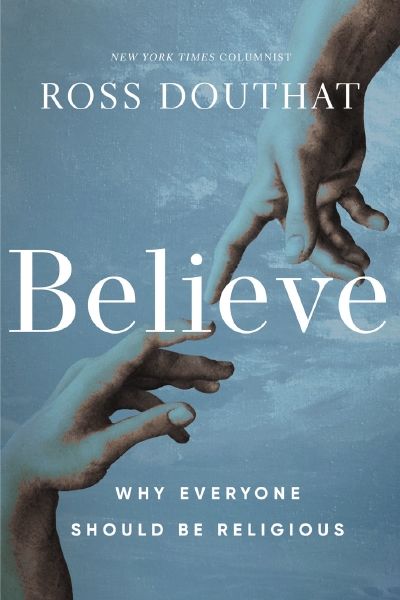
What does this mean? That’s the question Ross Douthat sets out to answer in his book, Believe: Why everyone should be religious. Our work at Ethos includes advancing religious freedom, but we live in an age where religion is at best irrelevant or at worst insidious in the eyes of many. So it’s worth considering whether we should respect religion (and therefore religious freedom). Douthat makes a strong case that religious belief corresponds to truth, which we’ll summarise.
Who is Douthat, and why is he writing?
Ross Douthat is a columnist at the New York Times, a conservative and Christian inside a liberal and secular institution. He’s also an increasingly prominent podcaster (a recent interview with Peter Thiel clocked up over a million YouTube views), an author (this is his seventh book), and a well-travelled speaker. He’s often acted as a translator, interpreting conservative and religious ideas to his liberal readers and attempting to show his natural allies what the world looks like through those readers’ lenses.
That’s part of the reason Douthat wrote this book but, he says, he also sensed a shift in sentiment. The sheer anti-religious hostility of early millenium New Atheism had receded, and in its place “[m]ore and more of my readers seemed to experience secularism as an uncomfortable intellectual default, not a freely chosen liberation.” Simultaneously, more and more public intellectuals were becoming open to the idea that religion in general, and Christianity in particular, might be “sociologically true,” as the writer Louise Perry put it.
Douthat argues that it is not only sociologically true, but scientifically and supernaturally true as well. He makes his case in two main sections, roughly equal by page- and chapter-count. First, he says that there are good reasons to be religious—not just to think that religious belief is plausible, but that it’s persuasive. Second, he turns to the vexed question, “which religion?”
Part 1: There are good reasons to be religious
Turtles all the way down?
There’s an apocryphal story about an existence-explaining myth that goes like this: the earth is held up by elephants, standing on the back of a turtle. What’s the turtle standing on? Another, bigger turtle. What’s that turtle standing on? It’s turtles all the way down.
Something like this is probably how many people think about religious belief, as an irrational exertion of blind faith, a posture that has been dealt a mortal blow by the inexorable advance of science. In chapter 1, Douthat sets out to overturn this view. He points out, for example, that evolutionary theory “did not explain the law-bound material substrate required for evolution to take place”. Nor did it explain where that material came from. On the latter, the Big Bang theory gels with the Christian idea of a universe brought into being at a specific moment. On the former, “it seems clear that our universe is held together by a set of seemingly excruciatingly carefully chosen values” and that life would be impossible if any one of them were even fractionally different.
Renowned New Zealand physicist Jeff Tallon puts it like this:
Some people have the idea that science is slowly unpacking the universe, slowly explaining everything, squeezing God out, as though God was just the bit that filled in the gaps in our understanding. But actually the reverse has been happening. Science has been unravelling the layers upon layers of mystery that exist within the universe. It is a profoundly improbably [sic] universe, and I find it impossible to address the universe without addressing the originator of the universe. For the first time in the history of humankind we can put probabilities on things and we can see that it is just profoundly improbably [sic]. On a purely random basis you and I should not exist, but we do.
The “hard problem” of consciousness
From this big-picture ‘argument from fine-tuning,’ Douthat turns to the focused example of the mind. The rise of neuroscience led some to believe that we would uncover all the secrets of the brain and that they would reveal the mind to be nothing more than an “analog chemical computer”. But something like the reverse has happened.
Even as we’ve learned more about the brain, the mind has remained a mystery. We do not know, for example, how “a specific burst of activity in some particular set of neurons” generates our inner emotional states. The most we know is which areas of the brain are associated with some types of mental or emotional states, but that does not tell us why or how those states exist. It’s a little like being able to locate a car’s engine, says Douthat, but not being able to explain how it works.
This is the “hard” (because it’s insoluble) problem of consciousness: “nobody has any idea how or why the physical inputs that go into conscious experience, the stimuli from particular chemicals or light waves or exchanges between neurons, yield the actual experiences themselves.” The mind is more than the brain, and the origins of the mind remain as much of a mystery to science as they ever did.
Shermer’s radio
The radio in the opening story belonged to Michael Shermer’s wife, and in chapter 3 Douthat cites it as evidence of “the persistence of supernatural happenings, and the credible reasons to think that material reality isn’t a closed system but one zone, and a porous zone at that, within a larger whole.”
He cites other examples, including a famous case report in the British Medical Journal of a symptomless woman who heard voices telling her (apologetically) that she needed a brain scan. When her psychiatrist eventually referred her for a scan, it revealed a tumour which was duly removed with surgery. The psychiatrist (and the internet at large) offer various explanations for this, many or most dismissing the possibility that something supernatural could be at work. Maybe it was all a coincidence or an extended series of hallucinations, but Douthat suggests that those who embrace those explanations uncritically do so simply because they have been conditioned to disbelieve in non-material reality.
In fact, many people believe there is more to life than meets the eye. In a 2023 study, only a quarter of New Zealanders said they had no spiritual beliefs or couldn’t describe any such beliefs. The common Māori health framework, Te Whare Tapa Whā, describes four “walls” of the house that makes up health. One is taha wairua, or spiritual wellbeing, which is at least a belief and perhaps a recognition that there is a real spiritual dimension and therefore spirituality is a part of what makes us whole and healthy.
“You are probably not a religious genius”
If you’ve followed Douthat so far, he now urges readers to consider the case for commitment. Not, at this point, to any particular religion, but simply to the prospect of belief. He admits that the path narrows here; it’s one thing to nod along with the broad argument, it’s another to actually step out and make a commitment.
Particularly as the path doesn’t just narrow, but forks. There are many religions, so how do you know which one to choose? Douthat’s first piece of advice is to acknowledge that none of us is likely to be a religious genuis, and therefore that there is wisdom in beginning your quest with one of the world’s enduring and established religious traditions. Here he stands against pop culture pick ‘n’ mix spirituality which, he says, “presumes a lot upon the strength of your individual intellect and moral compass”.
Not only that, but sticking with established approaches “offer spiritual protections that aren’t available on your own.” If the world is actually enchanted rather than disenchanted, then it’s possible that not every part of that supernatural reality wants what’s best for you. There’s safety in settings that have thought deeply about these things. And, says Douthat, more than that, there may be truth.
Part 2: Which religion?
Of Tash and Aslan
Early in the second half of the book, Douthat recounts the ending of CS Lewis’ The Great Battle (spoiler alert if you’ve not yet read the Narnia series). In it, a young man called Emeth enters into heaven—not because he worshipped Aslan, the true God, but because during the course of his devotion to the vulture-demon Tash, the virtue he manifested in fact served Aslan without Emeth knowing it.
The point is not that all paths lead to God or that every virtuous person enters into heaven, Douthat says.
The idea, rather, is that if some kind of God exists and ordered the universe for human beings, then even a false or flawed religion will probably contain intimations of that reality, signposts for the discerning pilgrim, some kind of call to higher things—such that a sincere desire to find and know the truth can fail to reach truth’s fullness and still find its reward.
That reality is most likely to be signposted where we find “collective insights rather than just individual ones, in traditions that have inspired entire civilizations, not temporary communities.” That is, it’s most likely to be found in the major world religions. Again, this does not mean all these religions are equally true (“it was not a matter of indifference to Lewis whether people worshiped Aslan or Tash”). Given the audience Douthat has in mind, it’s meant as a starting point, a way to narrow down the selection of forks in the road. To make an actual choice between them, he says, start not with what they have in common, but with where they differ, knowing that if the path you choose turns out to reflect the truth partially not fully, you can always change course.
Obstacles on the path
By now we’re in chapter 6, where Douthat recognises that seekers after religion might balk at some of the moral and ethical critiques of religion’s plausibility.
The first is the problem of pain and suffering: either God is good but not powerful (or He would prevent suffering) or He is powerful but not good (because He allows it). This, says Douthat, rests on an unacknowledged religious premise: “jumped-up apes” powered by “analog chemical computers” are not qualified to “pass moral judgment on anything or anyone, must less the universe’s Architect”. To assert otherwise “is to already assert something about human beings’ stature and capacity that only a religious conception of the human person can seriously allow.” And it conflicts with the history of human experience, populated as it is by people who chose “resilient belief” in the face of much greater suffering than the average inhabitant of the twenty-first century West.
The second potential obstacle to belief is the evil and injustice perpetrated by religious institutions. Douthat starts by noting that this is true of every sphere of human activity, yet we don’t suggest that we should do without families, commerce, or governments just because they have been and are sites of sin and oppression. And, he says, it is “worldly and secular aims of conquest or resource control that drive most warfare”—one history of warfare considered nearly 1,800 conflicts and put just 120 of them in the “religious wars” category—while “the very idea of Christendom” is an example of the religious attempt “to transcend the local, familial, and national loyalties that actually drive most human conflict.”
The third obstacle arises in the aftermath of the sexual revolution. The revolutionaries rejected traditional religious sexual ethics, and when their descendants aren’t rejecting religious institutions as a result they’re trying to remake them. But these ethics are a more integral part of religious belief and practice “than the liberalizers sometimes want to believe.” Indeed, says Douthat, it would be strange if God cared about our finances, politics, and other choices, “but somehow didn’t give a damn about behaviours that might forge or shatter a marriage, create a life in good circumstances or terrible ones ... bind someone to their own offspring or separate them permanently.” That recognition should be enough for an explorer to let go of their reflexive dismissal and at least “be curious about what that religion’s rules might be getting right” about sex and its associated ethics.
Where might you end up?
There have been a number of high-profile converts to Christianity in recent years—for example, former New Atheist Ayaan Hirsi Ali and her husband, the historian Niall Ferguson, environmentalist and author Paul Kingsnorth, writer Louise Perry, podcaster Tammy Peterson, and philosopher Matthew Crawford. They are examples, and perhaps inspirations, of people who have made the leap from unbelief to belief (or in Kingsnorth’s case, from one kind of belief to another).
Sometimes cases like these are dismissed on the basis that they simply represent people clinging to their ancestral or civilisational roots. Douthat acknowledges that belief is often “heritable”, thus conversion arguably represents a response to conditioning. This is obviously not true in all cases—as he says, Hirsi Ali was brought up under Wahhabi Islam—but it is true that people are more likely to opt for the religion they are most familiar with.
This is not a reason to reject religion, says Douthat. For one thing, it’s true of all beliefs—children brought up atheist are more likely to remain atheists, liberals to remain liberal, etc. And the mere fact of social conformity doesn’t mean the beliefs in question are false, just that we should have “humility in belief [and] sympathy for others who have ended up in different places”. It is, he argues, better to choose something rather than nothing, even if it is simply adopting the predominant faith: “God can do infinitely more with imitation than with no activity at all.”
A case study: Ross Douthat
Douthat ends by giving an account of his own position, as someone who after taking his own advice has reconfirmed his belief that Christianity is true and his commitment to the Catholic church. Against the possibility of “perennialism”—the idea that all the great religions contain truth and God can be approached through any of them—he confesses his belief “that God has acted in history through Jesus of Nazareth in a way that differs from every other tradition and experience and revelation”. Here’s how he puts it:
... if you find within human history (not just human myth and legend) a singular and well-attested happening, an especially dramatic and compelling story set in an especially earthy and human context, through which the order of the world was forever altered, a religious event [that] seems to stand out starkly from the historical record; if this event looks stranger and more credibly miraculous than other religious foundings; if the specific nature of its miracle seems to stand out from the wider range of stories about saints and sages and holy men and women; if its sheer strangeness still echoes down the centuries despite all the attempts at reinterpretation and domestication—well, then the simplest interpretation of that discovery is also the literal-minded one: that the resurrection really happened, that here God intervened in human affairs decisively, that this is the defining revelation of His purposes, in whose light the larger run of mystical and spiritual experiences across cultures and civilizations should be read.
The reasonable thing to do is not just to pay attention but to believe.
Ross Douthat, Believe: Why everyone should be religious (Grand Rapids, MI: Zondervan, 2025)
Image: HarperCollins Publishers 2026


