
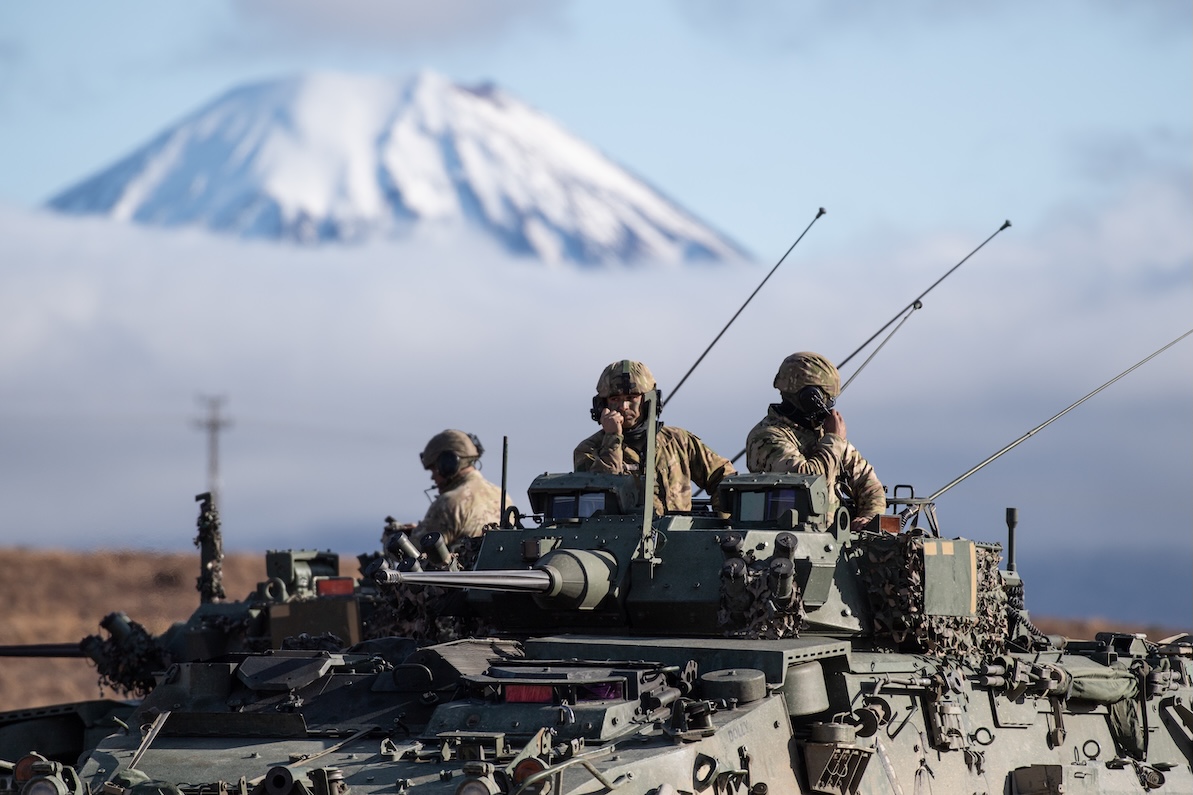
Tū is the god of war. He causes skirmishes, eats warriors, and orchestrates destruction. He is “a fierce and powerful deity.” So says the New Zealand Army, which describes its troops as Ngāti Tūmatauenga—the people of Tū.
This description is from the Army General Orders – Personnel, the subject of much controversy earlier in the year. Most of the debate focused on the Order as an extension of the Army’s bicultural policy, like expecting senior leaders to be proficient in te reo Māori, to have “detailed knowledge of kaupapa Māori methodologies and frameworks”, and to be “[a]lways up to date on contemporary Te Tiriti issues”.
But the religious significance of the Order cannot be overlooked. After controversy about the Order broke out, we used the Official Information Act to ask the Army about any consideration it had given to the policy’s and Order’s implications for freedom of conscience, religion, and belief. A few days ago, we received the irresponse: “the information does not exist”.
Where does this leave troops who don’t share these beliefs, whose own faith may put them directly at odds with this purported foundation for service? Apparently, the Army has not thought this through.
The Order is meant to provide “a single point of reference for all Army personnel matters”, and failure to comply with it can have disciplinary consequences. The Order references section 39(b) of the Armed Forces Discipline Act 1971, which provides that failure to follow orders is an offence punishable by up to two years’ imprisonment. This is the context in which the Order explicitly states that “it is crucial” that Army personnel “understand the cosmological traditions associated with the deity whose name we bear.”
The “cosmological framework” invoked by the Orders features Tū and a pantheon of other traditional deities—Rongo, the god of peace, Papatūānuku, the Earth Mother, and Hine-nui-te-pō, the goddess of death. This framework “must inform our approach”, says the Army, which is “dedicated to fostering a bicultural environment that respects and integrates Māori cultural values and practices across all levels of the organisation.”
Central to this is a cultural skills framework that is meant to direct improvement and advancement within the Army. For example, Foundation Leaders should “level up” by understanding “who Tū and Rongo are and how they influence our kawa and tikanga”, and they must be able to “recite & translate basic karakia”. Operational Leaders are meant to be able to “sing at least six waiata and perform karakia from memory”, while a Strategic Leader “actively champions the value of Te Ao Māori.”
Perhaps service personnel will be allowed to fulfil these obligation in a way that fits with their faith commitments. Christians may be able to learn hīmene (hymns) as their waiata; agnostics and atheists may be able to recite karakia that omit any reference to deities. Even then, there are likely to be conflicts given the overarching cosmological framework. For example, the NZ Army haka expressly refers to Tū in both its short and long forms, and all personnel are expected to learn and perform this haka. It is difficult to imagine soldiers being excused from it or allowed to perform a different haka separately.
And if there were provision for freedom of beliefs, you’d expect the Orders to say so. In fact, there is only one reference of this kind, found in the section on visits to the Army marae. Here, at least, no-one will be “compelled, directed or pressured to undertake any duty within the cultural space if they believe they cannot perform it, or have personal or cultural reasons that prevent them from doing so.” It’s odd that the Army is aware that this may be an issue in this one area, but not elsewhere.
This matters because religious beliefs involve ultimate commitments. They provide the answers to existential questions, like “what is life for?”, “why is there something rather than nothing?”, and “am I the source of meaning and authority in my own life, or is there something beyond me?” We all have to ask these questions, and the answers provide us with purpose and identity. Being forced, explicitly or implicitly, to contradict them involves a form of betrayal—of self, and of the God or gods you serve. That is why we recognise freedom of religion and belief as a fundamental right, part of our heritage and affirmed in the New Zealand Bill of Rights Act 1990.
In some places the Orders treat the cosmological framework they invoke as a “narrative” and in other places as a reality (personnel should understand who deities “are”). Some might see this cosmology simply as a story, but such things are non-trivial for those who take spiritual matters seriously. To give an adjacent example, consider the Matariki deities now routinely referenced during our new public holiday. To some, they are just a legend. For others, like Archdeacon Lyndon Drake, a leader in the Māori Anglican church, the deities are a reality: “I doubt their benevolence, not their being,” he says.
So while the Order is meant to promote unity, creating a culture that emphasises a very specific spirituality is likely to have the opposite effect if it forces non-adherents into unconscionable positions. This seems almost inevitable; as the Order itself says, spirituality is integral to a Māori worldview and cannot be separated from other forms of wellbeing. Strategic Leaders are expected to actively champion this worldview. It is hard to see how it could fail to influence the implementation of the Order.
For now, the Order has been suspended for consultation in light of the recent controversy. This is an ideal opportunity for the Army to reconsider. First, it should obviously think hard about the importance of religious freedom and whether a single cosmological framework can command the adherence of all servicemen and women.
It is also an opportunity to consider other religious traditions and what they might have to offer. To take the most obvious example, Christianity has been part of this land for over 200 years and embraced by Māori and non-Māori alike. It has much to say about peacemakers and about those who bear the sword, and can offer a sophisticated theory of war and justice.
The Army should continue to reflect New Zealand’s unique history and the essential role of Māori culture and traditions in our past, present, and future. Traditional Māori spirituality and beliefs should be treated with respect, and none of this is meant to denigrate them in any way.
But the Army should also recognise that religious freedom is an essential part of our inheritance. No beliefs are neutral, and if the Army wants to find a genuine basis for unity in service it will have to consider whether its new approach is defensible.
That will mean difficult conversations about sensitive subjects—religion, culture, history, and politics—areas where angels may quite reasonably fear to tread.
Our service personnel can rise to this challenge, as they have to so many in the past, by drawing on their long and honourable tradition of courage in the most challenging conditions, and of commitment to this nation and all its peoples.
Disclosure: The author’s brother is the Minister of Defence. As at the date of writing, they have not discussed these issues.
A version of this article was published by LawNews on 4 June 2026 under the heading, "How Army orders sparked debate on religious freedom protections under BORA".
Photo: NZDF


